
UGC-NET 2024 Cancellation: All You Need to Know
New Delhi Visvas News - On June 18, 2024, lakhs of students took the University Grants Commission National Eligibility Test (UGC-NET), only to be informed the next day that the exam stands cancelled. The Ministry of Education announced the decision. The announcement started a debate about the integrity and sanctity of the prestigious exam.
- By: Pallavi Mishra
- Published: Jun 20, 2024 at 07:03 PM
- Updated: Dec 12, 2024 at 01:26 PM


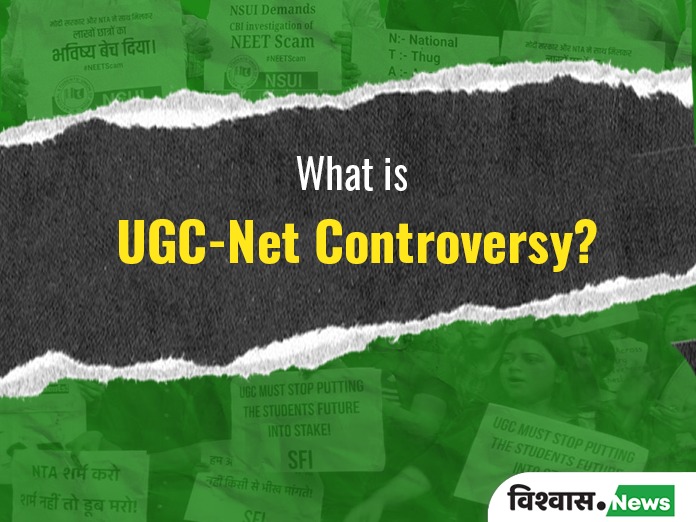
New Delhi Visvas News – On June 18, 2024, lakhs of students took the University Grants Commission National Eligibility Test (UGC-NET), only to be informed the next day that the exam stands cancelled. The Ministry of Education announced the decision. The announcement started a debate about the integrity and sanctity of the prestigious exam.
A total of 11,21,225 candidates registered for the UGC-NET June exam, and 9,08,580 finally appeared.
The Importance of UGC-NET
The UGC-NET is a prestigious exam conducted to check the eligibility for roles, such as Assistant Professors and for Junior Research Fellowships (JRF)/PhD candidates in universities and colleges across the country. The exam is managed by the National Testing Agency (NTA) and is held twice a year, i.e., in June and December. The exam was usually conducted in a Computer-Based Test (CBT) mode.
What is NTA?
The National Testing Agency (NTA) was established in Nov 2017 under the Indian Societies Registration Act of 1860. It is an autonomous body that is responsible for conducting various entrance examinations for admissions to higher educational institutions. The agency administers exams such as NEET, JEE, CTET, GATE, GPAT, GMAT, CAT, and UGC-NET.
What’s the Latest Controversy?
The schema of this year’s exam was different as instead of the usual CBT mode, the test was conducted in pen, and paper format. However, the digital to manual switch did not go as smoothly as planned.
The change exposed vulnerabilities that possibly led to the cancellation of the exam. A day after the exam, reports began to surface about possible irregularities. As per the reports, the Ministry of Education received inputs from the National Cyber Crime Threat Analytics Unit of the Indian Cyber Crime Coordination Centre (I4C), after which the decision to cancel the exam was made. According to the ministry’s statement, “the integrity of the examination had been compromised”. The statement also emphasised the importance of transparency and sanctity in the exam process.
The official statement of the Ministry of Education reads, “To ensure the highest level of transparency and sanctity of the examination process, the Ministry of Education, Government of India has decided that the UGC-NET June 2024 Examination be cancelled. A fresh examination shall be conducted, for which information shall be shared separately. Simultaneously, the matter is being handed over to the Central Bureau of Investigation (CBI) for a thorough investigation.” As per the latest reports, the government has handed over the matter to the Central Bureau of Investigation(CBI) for a probe.
The decision to cancel the UGC-NET exam comes after the controversy of the National Eligibility cum Entrance Test (NEET), putting additional pressure on the agency to come out clean.
What Does The Law Say?
Parliament passed a tough new law to prevent paper leaks in February 2024. The Public Examinations (Prevention of Unfair Means) Bill, 2024 aims to control unfair practices in public exams to ensure transparency. The law clearly defines “unfair means” to include actions like leaking question papers, tampering with answer sheets, and conducting fake exams. The said law covers five public examination authorities: (1) UPSC – Which conducts Civil Services, CDS, CMS, Engineering Services (2) SSC – Which recruits for Group C and B jobs (3) RRBs – That recruit Groups C and D in Indian Railways (4) IBPS – That hires for the nationalised banks and RRBs; and (5) NTA – Which conducts JEE (Main), NEET-UG, UGC-NET, CUET and more.
The violations under this law are treated as serious offenses, punishable with 3 to 5 years in prison and fines up to Rs 10 lakh.
UGC NET Eligibility Criteria:
(1) Applicants must hold a Master’s degree in a relevant field from a recognised university.
(2) The upper age limit for JRF applicants is 30 years (with potential relaxation for the reserved categories).
(3) A minimum of 55 percent marks in the Master’s program is required (or 50% for some categories).
Where to check new dates for the UGC-Net exam?
For the latest updates on exam dates, please visit the official University Grants Commission website.

Know the truth! If you have any doubts about any information or a rumor, do let us know!
Knowing the truth is your right. If you feel any information is doubtful and it can impact the society or nation, send it to us by any of the sources mentioned below.